
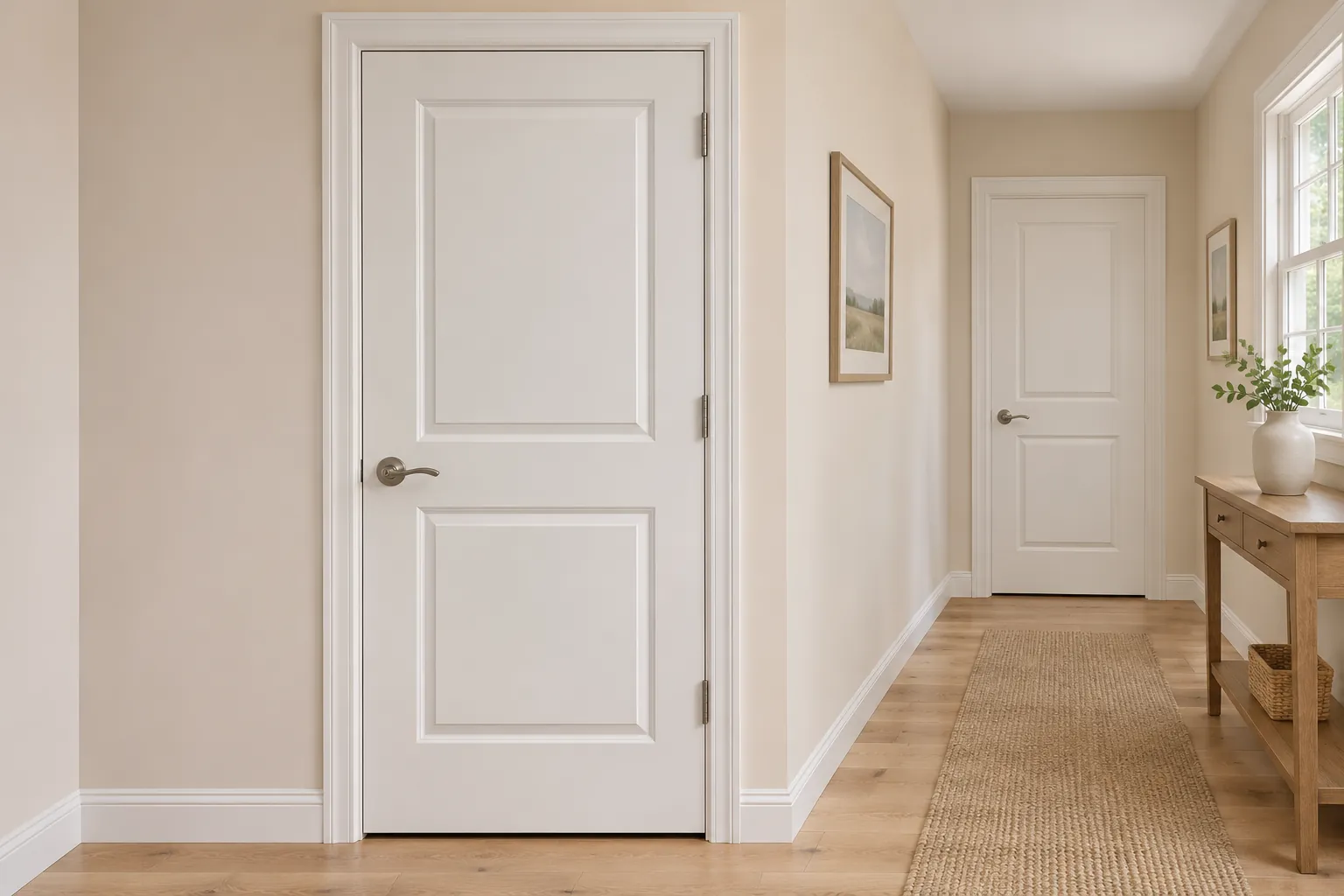
Quick answer
Solid-core doors generally use a denser interior than hollow-core alternatives and are worth considering where sound management and a substantial feel matter. Hollow-core doors may suit openings where those priorities are lower. Choose using the exact product specifications, the condition of the frame and the complete installation scope, not the name alone.
Neither label gives a universal acoustic rating, moisture rating or permission to trim the door. A solid-core door is also not necessarily a solid-lumber door.
What the terms tell you
Construction descriptions vary by manufacturer and product family. Ask what forms the core, edges and faces of the proposed door. Look at the panel's stated weight, available sizes, hardware preparation and finishing requirements.
Masonite describes its solid-core products as using more material than its standard hollow-core products, with greater density and weight. That supports a comparison within the described range. It does not make every solid-core product identical or establish a measured result for your room.
Compare the decision points
| Question | Solid-core option | Hollow-core option |
|---|---|---|
| How much does it weigh? | Check the specified weight and support requirements | Check the specified weight; do not assume old hardware is suitable |
| Is sound reduction a priority? | A useful starting point for an appropriate door assembly | Compare the actual assembly's evidence before relying on it |
| Can the panel be cut to fit? | Only within the manufacturer’s limits | Only within the manufacturer’s limits |
| Will it tolerate a bathroom's conditions? | Requires product-specific suitability and finishing checks | Requires product-specific suitability and finishing checks |
| Is it a simple replacement? | Depends on frame, preparation and installation scope | Depends on frame, preparation and installation scope |
Notice that several decisions have the same answer: check the specific product. Construction matters, but it is only one part of the purchase.
Sound control is more than the core
TruStile publishes sound ratings for named door and hardware combinations and explains that perimeter sealing and sound-control hardware affect the rating. A number from a tested assembly should not be detached from those conditions and applied to any panel that looks similar.
If you are improving a bedroom, ask what happens at the head, jambs and bottom of the door. Also consider other sound paths, including walls and ventilation. A new panel cannot guarantee silence, and soft furnishings that reduce echo inside a room do not serve the same purpose as controlling sound transfer through an opening.
Our bedroom noise-reduction guide explains how to ask for useful evidence without assuming a promised decibel improvement.
Weight changes the replacement question
A heavier panel should prompt an assessment of the hinges, screws, frame and supporting structure. Do not assume that an old frame is ready simply because the new slab has the same outer dimensions.
A slab replacement also needs compatible hinge locations, thickness, edge preparation and latch position. A prehung unit changes the scope again. Ask the installer to explain whether the proposal reuses or replaces those parts and what finishing work remains afterward.
Put the budget where the need is
Rather than upgrading every opening automatically, rank the rooms. A bedroom next to a busy hallway may have a different need from a linen closet. Compare complete, like-for-like proposals for the openings you actually want to improve.
We do not provide a universal price difference here. Product range, size, finish, hardware and installation conditions change the scope. A slab-only shelf price cannot establish the cost of a completed replacement.
Before ordering, write down the exact product name, core construction, panel dimensions, weight, compatible hardware and trimming limits. For a bathroom, add the manufacturer’s environmental and finishing requirements. Use the room-by-room buying guide to connect those specifications to the way each room works.
Sources and methodology
- Masonite: solid-core doors — The manufacturer’s stated density and weight comparison.
- TruStile: sound door ratings — Examples of ratings tied to specified doors and acoustic hardware packages.
- Masonite: professional resources — Construction, handling, finishing and warranty documentation.
This is a desk-researched comparison of materials and layout choices, not a hands-on product test. Manufacturer guidance applies to the products and assemblies it describes. Our room recommendations are editorial judgments; confirm the specifications and installation instructions for the exact door and hardware you choose.