
Quick answer
Choose closet doors by what you need to reach behind them. Bifold panels fold into a stack, bypass panels slide across one another, and hinged doors swing into the room. Each changes the usable opening differently. Test access to drawers, hanging clothes and the ends of shelves before choosing the face style.
The closet's nominal width is not the same as its useful access. A door arrangement can fit an opening neatly and still leave a favorite drawer difficult to open.
Test your storage first
Open every internal drawer and pullout. Stand where you normally select clothes or lift a box from a shelf. Check both ends of the closet rather than only the middle. Note whether a panel, stack or handle would sit in the way.
If the storage layout is being redesigned, choose the doors and organizers together. Planning one first can force compromises in the other. A sketch with the panels shown open is more informative than a photograph with everything shut.
Compare the main closet door styles
| Style | How it opens | Access tradeoff |
|---|---|---|
| Bifold | Hinged panels fold together and move toward the side | The folded stack occupies some of the opening and projects outward |
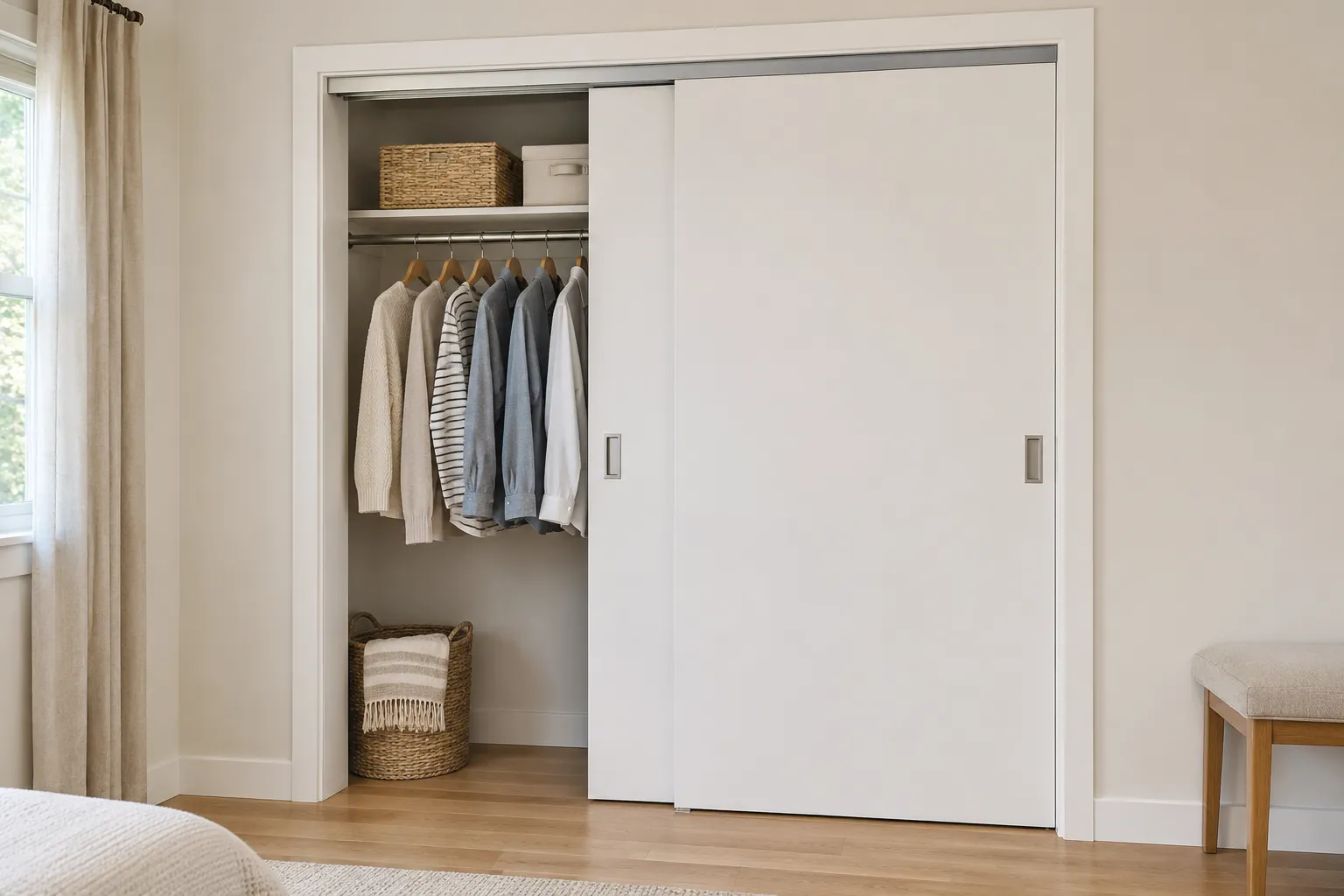
| Bypass sliding | Panels run past one another on tracks | An overlapping panel continues to cover part of the opening |
| Hinged | One or more panels swing away from the frame | Needs a clear swing and suitable hinge support |
| A panel slides into an adjacent wall cavity | Requires a suitable wall and an appropriate frame system |
Hardware designs vary, so check the exact open position and clear opening rather than borrowing a dimension from another system. Johnson Hardware publishes separate instructions for folding, sliding and pocket products; their requirements are not interchangeable.
Think about clearance in front of the closet
A bed, chair or laundry basket may be outside the closed closet but inside the operating area. Mark the panel movement on the floor and include the handles. For bifolds, consider the folded panels as a physical stack rather than treating them as if they disappear.
Sliding doors may avoid the room's swing area, but check where each panel parks and how you reach the section left behind it. A frequent task, such as taking out a wide storage bin, can make a particular opening style inconvenient even when there is no floor conflict.
Match the hardware to the panel
Confirm panel width, height, thickness and weight against the selected hardware instructions. Also check the required attachment surfaces, guides, pivots and stops. Do not assume that new heavier panels can be fitted to an old track without reassessment.
Look at the opening itself: is the track level, are the jambs sound, and has the floor level changed? A door that repeatedly jumps or drags may have a hardware, alignment or support problem. New decorative panels will not automatically correct it.
Decide what appearance needs to do
Opaque panels hide visual clutter. Glazing or mirrors can change the room's appearance, but they also change the panel specification and the way it must be supported. Check that the chosen complete door system is intended for that use.
Where the closet contains equipment rather than clothing, confirm access and ventilation requirements before covering the opening. Do not replace a specified ventilated or rated door simply to match a bedroom's decorative style.
What to measure and record
Write down the finished opening dimensions in several places, the floor finish and any trim that might obstruct a panel. Photograph the existing tracks, pivots or hinges if you plan to reuse part of the system. Follow the new product's instructions for allowances and preparation instead of assuming that every manufacturer uses the same sizing method.
Our bifold versus sliding closet door guide compares the two common access patterns in more detail. Use the room-by-room guide if you are coordinating closet doors with the rest of the house.
Sources and methodology
- Johnson Hardware: bi-folding door hardware — Examples of folding systems and their product-specific requirements.
- Johnson Hardware: sliding bypass hardware — Examples of overlapping sliding systems.
- Johnson Hardware: installation instructions — Dimensions, hardware compatibility and installation details for the chosen system.
This is a desk-researched comparison of materials and layout choices, not a hands-on product test. Manufacturer guidance applies to the products and assemblies it describes. Our room recommendations are editorial judgments; confirm the specifications and installation instructions for the exact door and hardware you choose.