
Quick answer
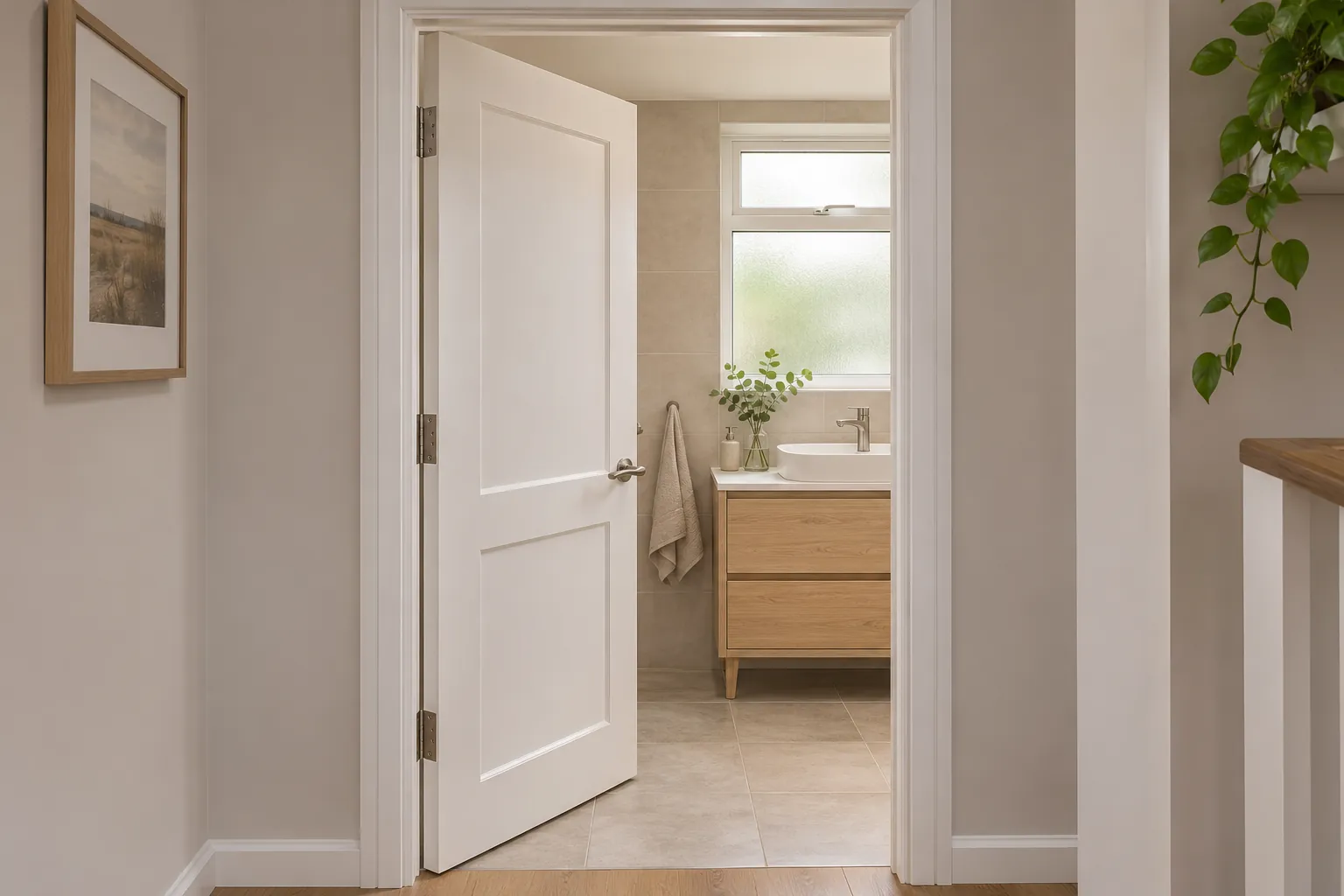
A bathroom door should close reliably, provide the privacy you need and suit the room's moisture conditions. Start with a properly specified and finished hinged door if the swing works. Consider a pocket or folding system when a measured clearance problem justifies it, and check the tradeoffs in privacy, hardware and installation.
Changing the panel does not solve persistent condensation or a ventilation problem. The EPA identifies controlling moisture as central to preventing indoor mold growth. Treat repeated dampness as a room condition to address, not a reason to assume a different decorative door will be waterproof.
Separate humidity from direct wetting
A door beside a basin can face a different exposure from one safely away from splashes. Look for where water actually lands, whether condensation persists and whether the bottom edge has been damaged. Check the proposed product's approved use and finishing instructions for that situation.
Terms such as painted, primed, engineered or solid-core do not independently establish that a door tolerates direct wetting. Ask for the exact product guidance rather than assuming a material label answers the moisture question. Complete the specified finishing work before putting the door into service.
Compare the opening styles
| Door style | A useful reason to consider it | Main planning question |
|---|---|---|
| Hinged | Familiar operation and a conventional latch arrangement | Does the swing conflict with fixtures, people or the hallway? |
| Avoids a hinged swing in the bathroom | Can the wall accommodate the system and its hardware? | |
| Bifold | Reduces the sweep of an individual hinged panel | Are privacy, finger clearance and the effective opening acceptable? |
| Wall-mounted sliding | Keeps the panel outside the room's swing area | Are closed-panel gaps and the required wall run acceptable? |
A smaller swing does not automatically mean a more usable bathroom. Draw the door fully open and closed, then test whether a person can approach the handle, move through the opening and use the fixtures comfortably.
Consider privacy beyond a lock
Privacy includes sightlines, sound and a door that actually latches. A panel with frosted glazing may obscure detail while still revealing movement or silhouettes under some lighting. Check a sample under realistic conditions instead of assuming any obscured glass offers complete visual privacy.
A surface-mounted sliding panel can have clearances around its edges. Do not assume it closes or seals like a conventional hinged assembly. If privacy is the main goal, ask the supplier to explain the complete closed-door arrangement, including any latch and jamb details.
For privacy hardware, check how the selected mechanism works and how an emergency release operates. The exact lock's instructions matter more than a generic product-category name.
Do not trade ventilation for a tighter fit without checking
Bathroom ventilation and the home's airflow paths need to work together. If an installer proposes changing door-bottom clearance or adding acoustic seals, ask how the room's planned air movement will be maintained. This is particularly important when a door replacement is part of a wider effort to reduce sound.
If dampness keeps returning, investigate ventilation use, leaks and other moisture sources. Replacing a swollen panel without addressing the cause risks repeating the same project.
A checklist for the opening
- Measure the panel, frame and finished floor level.
- Mark the swing against the basin, toilet, shower screen and nearby cupboards.
- Check the door's intended environment and required finish.
- Confirm hardware, grip and emergency-release operation.
- Ask about wall contents before proposing a pocket frame.
- Have local access, safety and building requirements checked where relevant.
Our small-bathroom door guide focuses on layout conflicts. For material choices, read the solid-core versus hollow-core comparison while keeping moisture suitability as a separate product-specific question.
Sources and methodology
- EPA: A Brief Guide to Mold, Moisture and Your Home — Moisture control, condensation and indoor mold prevention.
- Masonite: professional resources and guides — Product-specific finishing, care and warranty documents.
- Johnson Hardware: pocket door hardware — The range of pocket systems and the need to match frame and hardware.
- Schlage: manuals and templates — Instructions for the selected privacy hardware.
This is a desk-researched comparison of materials and layout choices, not a hands-on product test. Manufacturer guidance applies to the products and assemblies it describes. Our room recommendations are editorial judgments; confirm the specifications and installation instructions for the exact door and hardware you choose.